
Understanding the 3 Most Common Analog Output Types: 4-20mA, 0-10V, and Ratiometric
Published
Not all sensors speak the same language. Understanding the differences between 4-20mA, 0-10V, and ratiometric outputs helps you select the right instrument for your application and avoid costly compatibility mismatches.
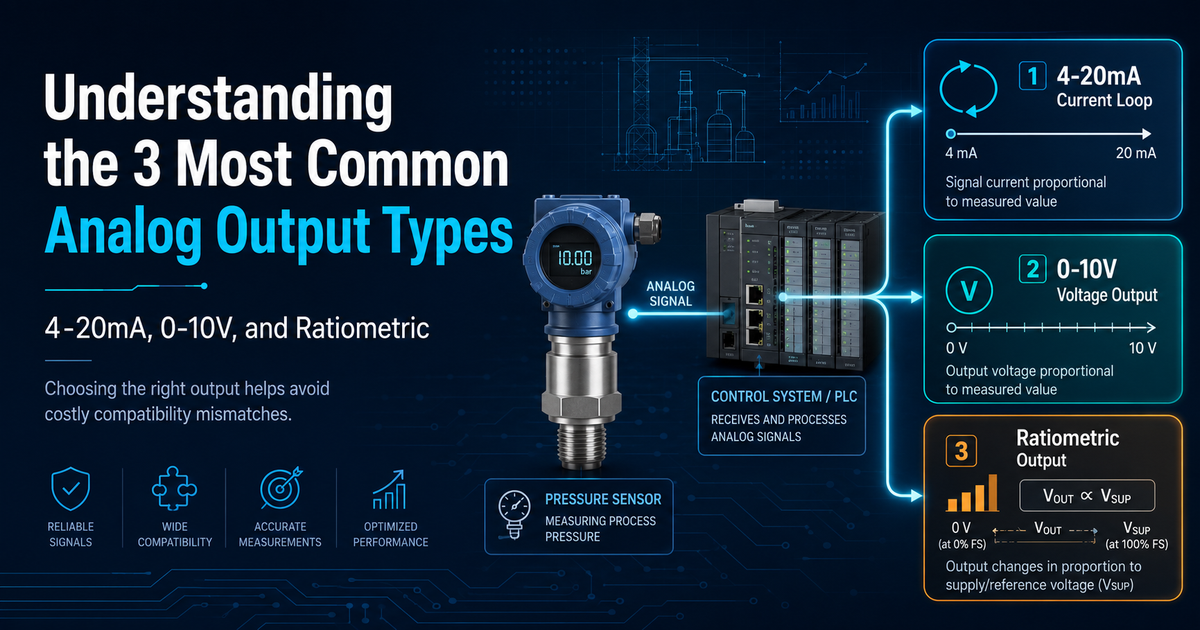
Walk into any industrial facility and you'll find sensors and transmitters outputting signals in several different formats. The three most common are 4-20mA current loops, 0-10V voltage outputs, and ratiometric voltage outputs. Each has its own strengths, limitations, and ideal applications. Knowing the difference saves time during design and prevents headaches during commissioning.
4-20mA Current Loop
The 4-20mA current loop is the standard for industrial process measurement and control. It transmits measurement data as a variable current — 4mA at the low end of the range, 20mA at the full scale.
The primary advantage is immunity to electrical noise and resistance to signal degradation over long cable runs. Because current is the signal carrier rather than voltage, resistance in the cable doesn't affect accuracy. This makes 4-20mA ideal for field instruments located hundreds or thousands of feet from the control room.
The live zero at 4mA is another significant advantage. Because a healthy loop never drops to zero current, a reading of 0mA immediately indicates a fault condition — a broken wire, a failed transmitter, or a loss of power. This makes loop integrity monitoring straightforward.
4-20mA is the right choice for: pressure, temperature, level, and flow transmitters in process industries; any installation with long cable runs; applications where noise immunity is critical.
0-10V Voltage Output
The 0-10V voltage output is common in building automation, HVAC, light industrial applications, and motion control. It transmits measurement data as a variable voltage — 0V at minimum, 10V at full scale. Some variants use 0-5V or 1-5V ranges.
The main advantage of voltage outputs is simplicity. No loop power supply is required — the sensor just needs a DC supply voltage and a signal wire back to the receiver. Many PLCs and building automation controllers have voltage inputs as standard.
The limitation is sensitivity to cable resistance and electrical noise. Over long cable runs, voltage drop across the cable resistance introduces measurement error. Voltage signals are also more susceptible to interference from nearby motors, drives, and power wiring.
0-10V is the right choice for: short cable runs in clean electrical environments; HVAC sensors and building automation; applications where the receiving equipment only accepts voltage inputs; situations where loop power supply is not available.
When you have a 0-10V sensor but need a 4-20mA input — or vice versa — a signal converter like the ISOCON handles the translation cleanly without any programming or complex wiring.
Ratiometric Output
Ratiometric output is less commonly discussed but widely used in pressure sensing, position sensing, and load cell applications. A ratiometric sensor outputs a voltage that is proportional not to a fixed reference, but to its supply voltage.
For example, a ratiometric pressure sensor powered by 5V might output 0.5V at zero pressure and 4.5V at full scale. If the supply voltage changes to 4.9V, the output shifts proportionally — 0.49V at zero and 4.41V at full scale. The ratio between output and supply voltage stays constant regardless of supply variations.
This is actually a significant advantage in certain applications. If your supply voltage drifts slightly, a standard voltage output sensor would show a measurement error. A ratiometric sensor compensates automatically because the receiving device (typically a microcontroller or specialized analog input) measures the ratio of output to supply, not the absolute voltage.
Ratiometric outputs are common in automotive sensors, industrial pressure transducers, and any application where the sensor and receiver share the same power supply and supply stability is a concern.
Ratiometric is the right choice for: pressure sensors interfacing directly with microcontrollers or specialized analog inputs; applications where supply voltage stability is a concern; position and force sensing in embedded systems.
Choosing the Right Output for Your Application
The decision usually comes down to three factors: cable length, electrical environment, and what your receiving equipment accepts.
For long runs in noisy industrial environments, 4-20mA wins every time. For short runs in clean environments with standard controller inputs, 0-10V is simpler. For direct sensor-to-microcontroller interfaces where supply variations are a concern, ratiometric is the purpose-built solution.
When your sensor and your controller don't speak the same signal language, a signal conditioner or converter bridges the gap without requiring you to replace either device.